Thursday, February 9, 2012

How to test MLT186 power board for AKAI LCT3201TD / LCT321AD

Coppell TV Repair offers a repair service for power board MLT186 and as with many other services we sometimes receive boards that are actually functional.

(A similar article for power board MLT186B is available here.)
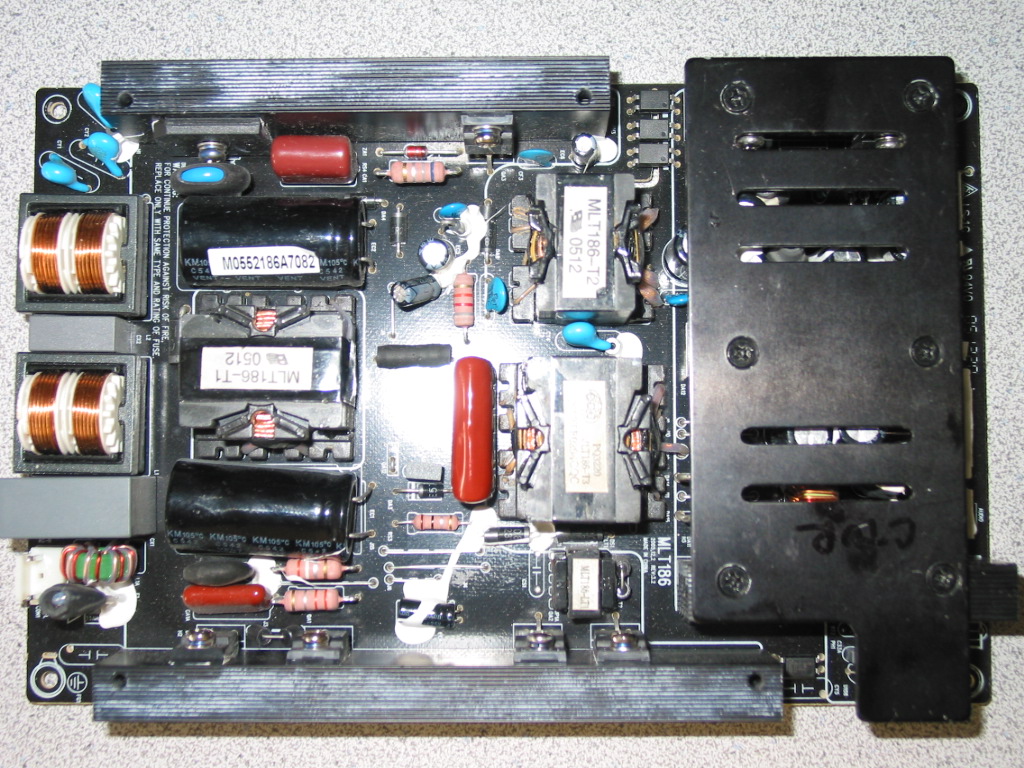


This post should help both those who wonder if their AKAI (or ILO) TV is dead because of the power board or the main board as well as those who receive a serviced power board from us and think it was not properly serviced.

MLT186 is relatively simple as far as power boards go. It produces one standby (always on) output voltage of 5V and, upon instruction from the main board, activates another , more powerful chain of the board, which produces additional channels of +5V, +12V and +24V.

All voltages are DC and all measurements are made with a multimeter in VDC measuring mode (dial pointing to VDC or V= sign), black probe touching any of the GND outputs or, if the board is mounted in a TV, any metal part of the chassis.
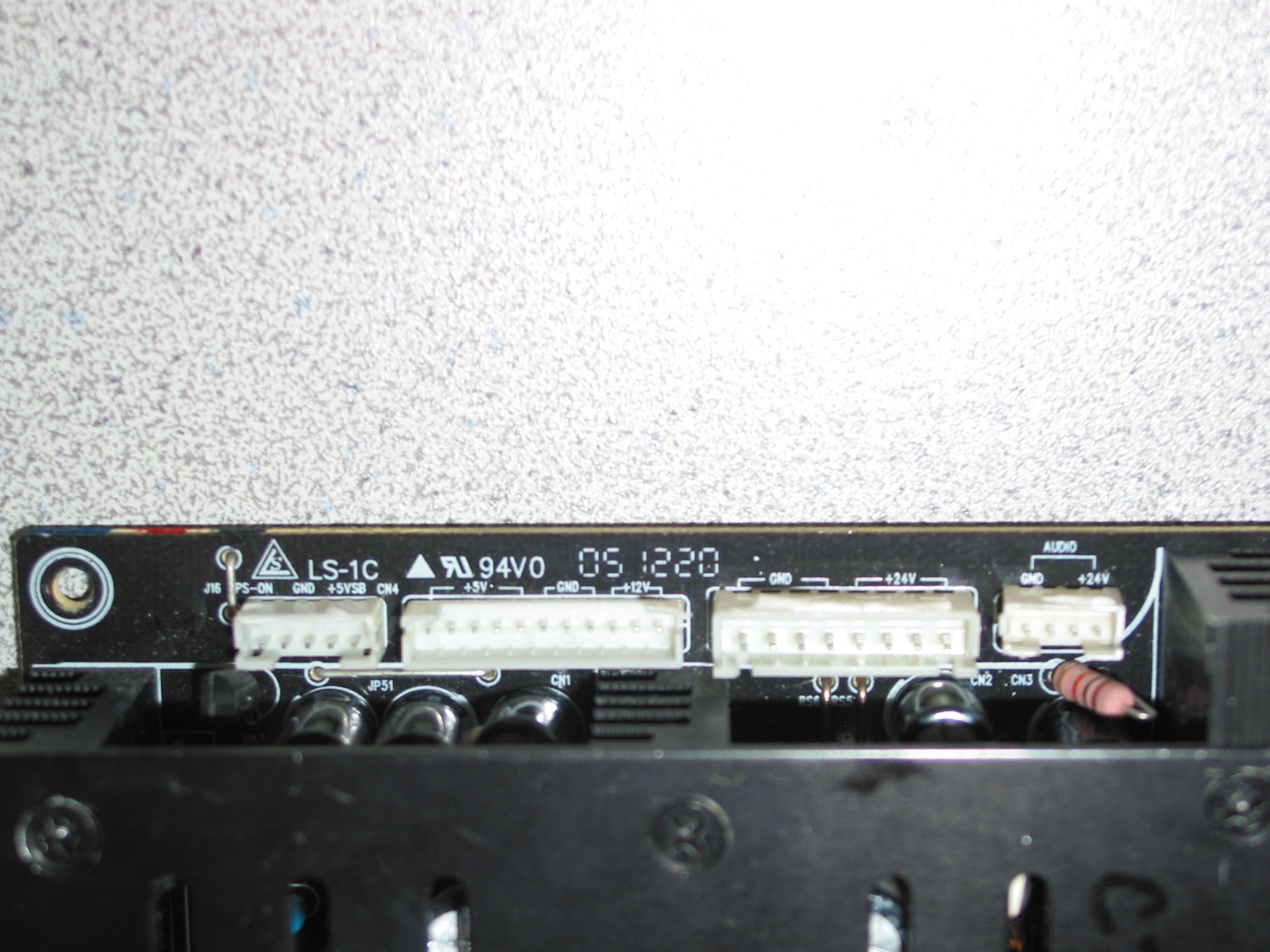


On the picture above (click to see it larger) you have the four connectors (CN4, CN1, CN2 and CN3) with the labels indicating pin meanings as follows:
  • On the first (leftmost) connector CN4:  1 x PS-ON, 2 * GND, 2 * +5VSB;
  • On the second connector CN1:  5 * +5V, 3 * GND and 3 * +12V
  • On the third connector CN2: 4 * GND and 4 * +24V
  • On the fourth (rightmost) connector CN3: 2 * GND and 2 * +24V (power for audio amplifier)
The +5VSB voltage is called standby voltage as it is active even when the TV is in standby mode.

It powers a small circuit on the main board, which is responding to the power button on the side and the remote control and when it detects you want to turn the TV off it sends back the +5V to the PS-ON pin on the same connector thus instructing the power board to wake up and get ready for work.


The first thing to test in any power board is the presence of this standby voltage, so using the multimeter in VDC (or V=, which is the same) mode, hold the black probe to any of the GND outputs and the red one to any of the two +5VDC pins on CN4.

A good test involves taking readings with both connector cables unplugged and then plugged; that can help determine if a power is working properly under load or failing to work under load.

We'd recommend testing everything here without any other cables connected to the board other than, of course, the main AC cable on the other side of the board.

Once the +5VDC voltage is there one needs to tell the board (signal it) to wake up the rest.

You can use the standard TV cable to do that or, if you're more handy, find a little jumper or, in our case, tweezers that can pass the +5VSB to the PS-ON pin as shown here:
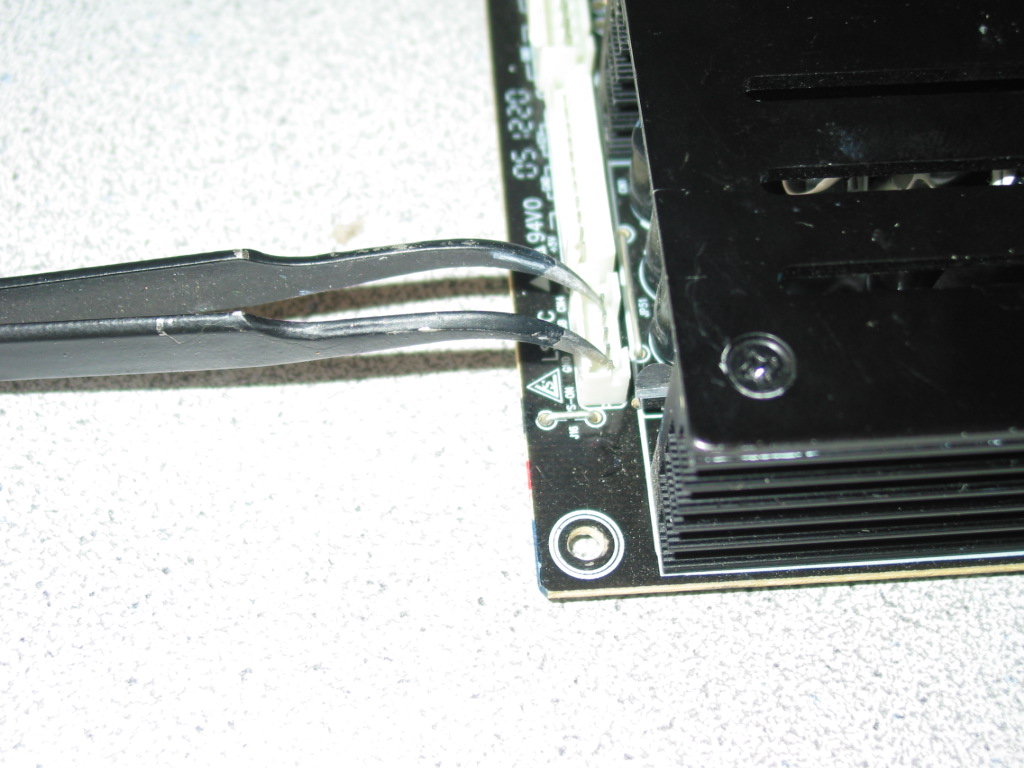
If that's hard you can just use a little jumper to solder the two opposite pins of the connector on the other side of the board.

Once done, all other voltages should appear.

Note: audio output voltage may be +18V and not +24V as labeled on the board; that's OK as long as it is stable.

Monday, January 16, 2012

Toshiba 50HP66 50" plasma, loud pop, screen went dim - what to do


Question: 
A friend of mine recommended you. i just bought a toshiba 50hp66 50" plasma. loud pop, screen went black. after sitting off for an hour turned it back on. everything works but is very light colored and dim. pictures seems to be clear, no lines,spots etc... not sure which board would cause a dim screen. thanks in advance.  Travis

Answer:
This is a known issue with Toshiba 50HP66 and a bunch of other TVs using the same display and supporting boards.
(in a plasma TV almost everything is about the display being used; same display in two different models means that bunch of other boards are also the same, namely the sustain boards, the buffer board(s) and the plasma display controller; the main board is different for different OEMs and that's about it. Oh well, the power board may also differ, but the differences would be very minimal, e.g. an extra 15V power needed by the main board).

Anyway, what goes bad with a pop is one of the sustain boards. Sometimes both, but most commonly just one of them at a time.

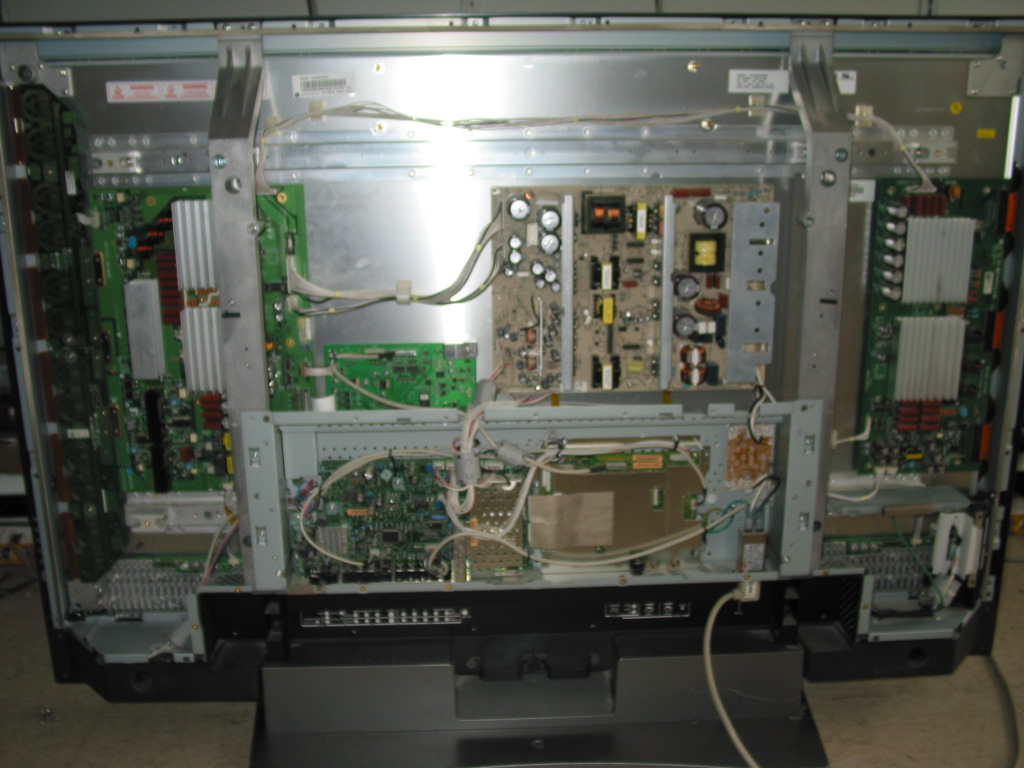
Here is how the TV looks at the back when you open it (click to get larger picture):

What usually goes bad is either the larger board with three heat sinks to the left of the TV (called YSUS board , or, sometimes Y-Main) or the one with two heat sinks at the right side of the TV (called ZSUS or sometimes X sustain).

Sometimes, but relatively rarely, it is the large board in the middle of the picture (and the TV) that goes bad  - that's the power board; if the TV is completely dead and has no front LED indication, no response to power button then the first thing to check is the power board.

Anyway, in your case it is mostly sure that it is either the YSUS or the ZSUS board that is bad.

And since you say you do have a faint, dark image on the display then it is most likely that it is the ZSUS board that has failed.

Here's a closer look at it:

Now, customers often ask how to make sure the board is bad before sending it.

They read around Internet and search for swollen capacitors , burn marks and other signs of a failure.

Well in case of those boards the truth is you don't normally see signs of a failure.

What fails is under the heat sink and above the board. There's simply no way for you to see it there, but for your eyes only I've blogged about the subject before so you can actually see what has happened there if you're curious:

http://blog.coppelltvrepair.com/2010/02/y-sustain-6870qyc004b-6871qyh039a.html

Sometimes the failure results in a short and that can be measured , but often times (as in your case) it results in an open circuit and that just can't be measured without applying power.

Which means the easiest way to test the board is to put it in a working TV to see if it will still be working.

And that's exactly what we do when we receive one of those for service.

If interested in using our service or servicing it yourself...here's a link for  you:

Toshiba 50HP66 repairs and modules from Coppell TV Repair

Sunday, December 4, 2011

Looking for B1DEKQ000003? The TH-42PX60U repair kit has it.

B1DEKQ000003 is a power FET made by Panasonic and used in a number of power modules such as power and sustain boards.

For whatever reason - sometimes I suspect it is simply a marketing trick to enforce customers and partners to use only their own brand - Panasonic seems to be constantly changing the naming conventions of their semiconductors, specifically power / IGBT transistors.

A Google search for B1DEKQ000003 on Dec 3 2001 would yield Encompass and PartStore at the top, each offering the above said transistor for about $50.

You can't get much specification about the transistor let alone a more reasonable price.

Well of course both exist - substitutes and more reasonable prices.

Take the repair kit for  TH-42PX60U's power board:


It has the B1DEKQ000003 (or substitute) and a few other parts on top of that and as of today (Dec 3rd 2011) it is on sale for half the price Encompass asks!

Don't know how it looks on your end, but where I'm from it's a no-brainer.

Saturday, November 5, 2011

LCX043AUB5 LCD panel for Sony KDF-55WF655 available

A customer asked us to find LCX043AUB5 for them and we bought a few along with the regular order from our vendor.

If you need the LCD you can get it here.

Monday, October 3, 2011

Is it really my problem that I do not speek Spanish / Chinese / Indonesian / whatever?

Lately there have been a few cases of customers accusing me of being rude or flat out stealing out of them.

The thing is, they do not speak English (and of course they do not read it) and any attempt to communicate to them that what they bought is not what they thought they were buying, but was what it SAID it was (in English) or any attempt to tell them that I can not understand what are they saying is, well, doomed as they do not speak English.

As you can see below one of them actually told me I *must* learn Spanish because there are 80 million Spanish speakers in USA.

Of course, considering he's the one with a problem in the first place it seems to me he should learn English although, in all fairness, I also see enough native English speakers who also buy based on what they *think* rather than what the listing says.

So perhaps it's even more important to learn to pay attention to what you are actually buying and applying common sense than learning another language.

And yet there are at least 200 million English speakers here in US and a recent study found the Hispanic children to be the largest poverty group in USA, ergo the least educated one.

So it seems to me the solution is to have everyone speak at least the official language of this country before they start accusing others. Maybe not perfectly - I myself am not a native English speaker either - but at least enough so you can communicate in the official language of the country.

If you can't then you should only blame yourself.

From where I stand I'd readily lose 80 million illiterate customers.

What do you think?

---

From: huongdao2010
To: coppelltvrepair
Subject: Other: huongdao2010 sent a message about YPPD-J015C YPPD-J016C NEW FOR 6871QYH039B 6871QZH044B #110666219259
Sent Date: Aug-15-11 04:14:51 PDT
                   
Hi !
My ic same part number excetp the letter E.A,B,C,E r they the same ?
thank

- huongdao2010
To:  huongdao2010
From:  coppelltvrepair
Sent:  Aug-15-11 08:56 AM
Dear huongdao2010,

The answer is in the listing description - make sure to read all of it!


- coppelltvrepair
----

From: huongdao2010
To: coppelltvrepair
Subject: Other: huongdao2010 sent a message about YPPD-J015C YPPD-J016C NEW FOR 6871QYH039B 6871QZH044B #110666219259
Sent Date: Sep-27-11 08:00:28 PDT
                  
Dear coppelltvrepair,

Hi !
i did not installed these ic until last week.It give me a very
wear symtom i got only half picture and disappear after 15second
other haft r in block.Look line the Ic were defective?Can do something
about this?
Thank

- huongdao2010
To:  huongdao2010
From:  coppelltvrepair
Sent:  Sep-27-11 10:16 AM
Dear huongdao2010,

I am sorry, I do not understand your English.

But from the little I understand it seems to me you have a bad buffer board.

If either of those ICs were defective you would not have gotten half an image.


- coppelltvrepair
================
> From:Armando Martinez [mailto:mandyelectricoatyahoodotcom]
>Sent: Wednesday, September 28, 2011 8:11 PM
>To: Coppell TV Repair
>Subject: Re: RECLAMACION
PURCHASE IN 09/12/2011    ID#27G75424W2450110K////ITEM#110637056886....I NEED THAT....6871QZH956A...YOU UNDERSTAND ME
 
>MRS ..KOLEV IN THE UNITED STATES NOW LIVES NEAR 80 MILLIONS 
> SPANISH  ,YOU MUST LEARNIG SPANISH FOR YOU JOB.....YOU SENT ME 
> WRONG ITEM  .I DON'T NEED REPAIR MY BOARD I NEED BOARD 
> COMPLETE ...PLEASE I WILL RETURN YOUR KIT....YOU MUST GIVE ME MY 
> MONEY...THANK...ARMANDO.I RETURN YOU THE  SAME WAY ....I WAIT FOR 
> YOU ANWSER...BLEASING.ARMANDO..EXCUSME..... 


Sunday, October 2, 2011

When 6871QYH039B fails, should buffers be replaced too? (same for 6871QYH039A, 6871QYH039B)

Question:

Hi. My concern is should I go ahead and get the Y-buffers too. Cant a bad buffer blow the new Y-sus? How can I check the buffers without replacing the Y-sus? Do you carry the buffers? Thanks, Geo.


Answer:
With this particular YSUS, an in fact with most sustain boards made by LG (at least in the 2004-2007 models) I would not worry about the buffers when a YSUS fails for several reasons:
 
First, the popular concept that when YSUS fails one should look for the buffers is most likely coming from the Samsung designs from the same time period. LG electrical design is similar and does not have the same failure characteristics as the Samsung boards.
In the Samsung cases it's the buffer board that fails first and damages the YSUS.

With LG, the sustain actually fails before the buffer and usually does not affect it.
Second, when the LG buffer ultimately fails (because that can happen too) it does not tend to damage the sustain. It is possible for it to happen, but it is rare.
 
Instead, when an LG plasma buffer board fails (e.g. in Toshiba 42HP66 or  50HP66) it will typically cause a vertical line as explained in this previous article.

As with any failure it is not guaranteed that it will happen that way. It's just the most common result.
 
So, in a nutshell, it's not worth worrying about the buffers at the time when you know the problem is in the sustain.
It's not bad to check them, but it would be unusual for them to have failed at the same time with the YSUS.


Saturday, October 1, 2011

LG 42PC5D YSUS EBR36954501 EBR39214401 question

Question: 
I am trying to fix an LG 42PC5D, no picture, does not pre-warm up the screen, the fuse on the YSUS board FS5 1.5 amp is blown, it blew again after replacing, it is connected to the STEP-UP/FLYBACK SWITCHING REGULATOR on the board, I don't have a schematic and working on plasma is new, without tracing the circuit board traces, is this something this driver chip would fix this problem?


Answer:

It might or might not, I can't promise.

That fuse doesn't usually burn when the IPM fails. It is not impossible for it to happen, of course, but if I were you I'd search where the high current to blow the fuse is coming from.

It may or may not be the IPM.